Getting your Basic Pilot Certificate is the simplest of Canada’s drone certification processes. There is no mandatory ground school or flight review, so you only need to pass Transport Canada’s online Small Basic Exam.
That said, read on to learn some tips and tricks to make the most of your preparation for the exam and the flying that follows!
Preparing for the exam
Transport Canada’s Small Basic exam tests 8 knowledge areas on the topics outlined in TP15263 –Knowledge Requirements for Pilots of Remotely Piloted Aircraft Systems, 250 g up to and including 150 kg, Basic and Advanced Operations.
- Air law, air traffic rules and procedures
- RPA airframes, powerplants, propulsion systems
- Human factors
- Meteorology
- Navigation
- Flight Operations
- Theory of Flight
- Radiotelephony
While the document linked above identifies what you are expected to know, it’s not designed as a study guide. Ground school is not mandatory for Basic certification, but Transport Canada recommends completing training before attempting the exam. Our Basic RPAS Ground School provides structured, self-paced instruction across the required subject areas, along with quizzes and practical walkthroughs of resources such as aeronautical charts, weather information, NOTAMs and the Canada Flight Supplement.
If your goal is not only to pass the exam, but to understand how to plan and conduct a safe, legal flight once you have your certificate, then ground school is well worth it.
Check out the resources listed below too for handy (and free!) info, too!
Writing the Transport Canada Exam
The Small Basic Exam is completed online through Transport Canada’s Drone Management Portal.
You must be at least 14 years old to write it. The exam currently includes:
- 35 multiple-choice questions
- 90 minutes to complete the exam
- A passing score of 65%
- A fee of ~$10* for each attempt
Your result is available immediately after you finish. If you do not pass, you must wait at least 24 hours before trying again, and the exam fee applies to each attempt.
*The fee increases every year with inflation. In 2026, it's $10.17.
Once you pass, Transport Canada issues your Pilot Certificate – Basic Operations through the Drone Management Portal. There is no flight review or separate application process required.
Should You Write the Advanced Exam Instead?
If you already expect to pursue your Advanced Pilot Certificate, you do not need to write both the Basic and Advanced written exams.
Passing the Small Advanced Exam will also give you a Basic Pilot Certificate. You can use that certificate to conduct Basic operations while you work toward the remaining Advanced certification requirement: the in-person flight review.
The Advanced written exam covers more material and has a higher passing standard, so it may not be the best route for someone who only needs Basic privileges. However, it can save you from writing and paying for two separate exams if Advanced certification is already part of your plan.
Keeping Current
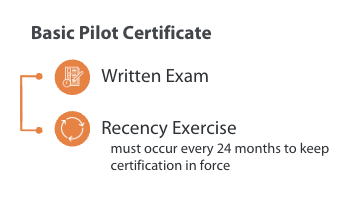
Your Basic Pilot Certificate does not expire, but to exercise the privileges of your certificate, you must have completed an accepted recency activity within the 24 months before your flight. For the first 24 months, your certificate issuance counts, so once you pass the exam set yourself a calendar reminder for ~23 months later, so you give yourself time to get it done.
This could include rewriting an applicable Transport Canada RPAS exam, completing a flight review or completing an accepted recurrent training activity, such as Transport Canada’s self-paced study program. You can read more about the available options in our guide to maintaining your RPAS pilot recency.
You must also keep proof of your recency activity and be able to access both it and your pilot certificate when operating.
Important Note!
All small and medium RPAS flights – basic, advanced or level 1 complex – require the use of standard operating procedures including the Site Survey, Normal and Emergency procedures. Make sure you’re meeting the CARs requirements of these for every flight you do!
Resources
RPAS 101
RPAS 101 is a free general-knowledge guide developed through cooperation between Transport Canada and the Aerial Evolution Association of Canada.
I was one of the contributors who helped write RPAS 101. We developed it to function much like a driver’s handbook. It’s an accessible starting point for understanding the information Canadian drone pilots need. It is useful for both new pilots and experienced operators looking for a refresher.
Transport Canada Aeronautical Information Manual
The Transport Canada Aeronautical Information Manual, commonly called the TC AIM, explains the rules and procedures used in Canadian aviation.
Drone pilots should be familiar with the dedicated Remotely Piloted Aircraft chapter, but relevant information also appears in sections covering airspace, aerodromes, weather, communications and navigation. The AIM is updated regularly, so make sure you are using the current edition.
Canadian Aviation Regulations
I linked to a few specific areas in the text above, but the CARs are a helpful resource to have open during the exam. They aren’t the most fun to read “cover to cover” but work well as a reference if you need clarity or the official information source on something.
Ready to get started?
If Basic certification is the right fit for your operations, the process is straightforward:
- Prepare using a ground school or the recommended study resources.
- Create or access your Transport Canada Drone Management Portal account.
- Write and pass the Small Basic Exam.
- Download your Pilot Certificate – Basic Operations.
- Maintain your 24-month recency before continuing to fly.
If you would like structured preparation, out Basic RPAS Ground School takes you through the required knowledge in a practical format designed specifically for Canadian drone pilots.