
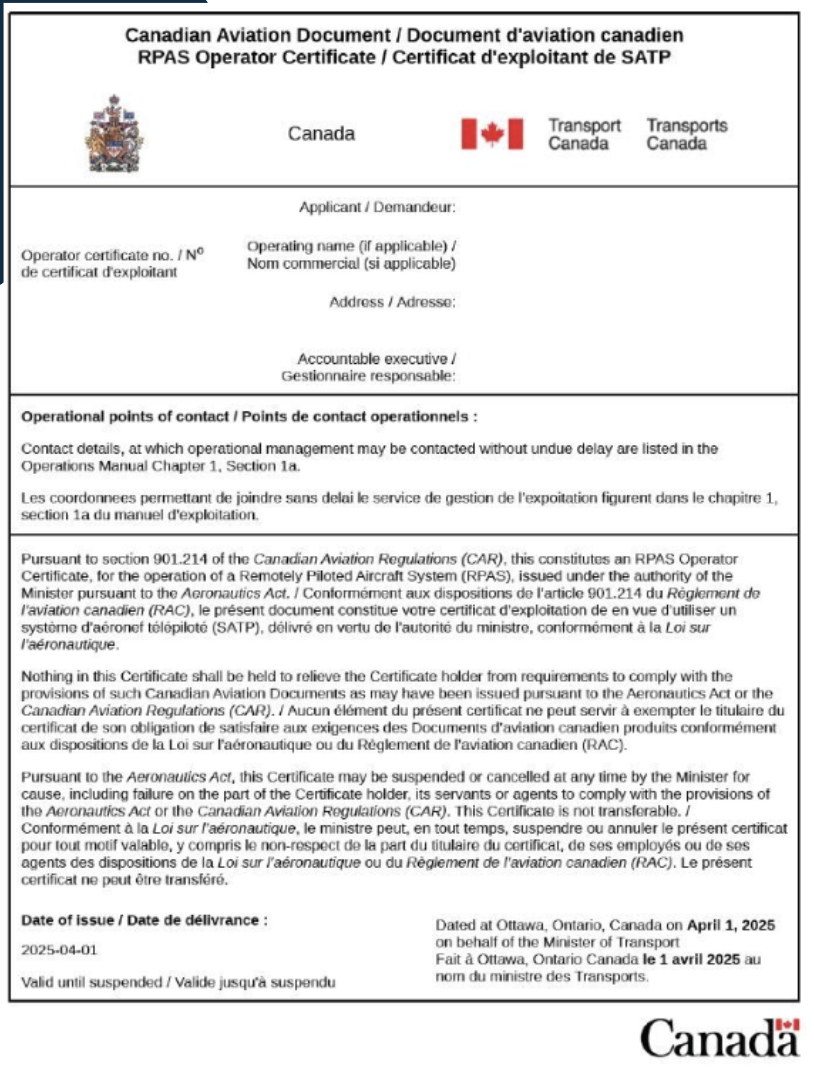
The latest data provided by Transport Canada shows we have 615 RPAS Operating Certificates (RPOC) issued to date. Considering it takes about 3 minutes on the Drone Management Portal and a credit card number, that shouldn’t be too surprising. What does sometimes come as a surprise – even to those who hold the RPOCs – is the level of exposure and business risk they’re creating to hold that certificate.
An RPOC Is Not a Status Symbol
An RPAS Operator Certificate sounds official. It looks good on a website and it may even reassure a client who does not know exactly what it means.
But an RPOC is not a general licence to operate drones professionally, a mark of superior competence or an aviation-themed badge to collect “just in case.” It is a regulatory certificate created for a specific purpose and unlike pilot certifications, holding one comes with ongoing responsibilities whether you use or it not.
If your organization needs an RPOC, those responsibilities are a necessary part of conducting Level 1 Complex operations safely and legally. If you do not need one, you may be volunteering for more paperwork and regulatory exposure without gaining any useful privileges.
What is an RPOC?
An RPAS Operator Certificate, or RPOC, is issued by Transport Canada to the individual or organization responsible for conducting Level 1 Complex operations.
The distinction between the pilot and the operator matters. A Level 1 Complex pilot certificate confirms that an individual pilot has met the applicable knowledge, ground school, examination and flight review requirements. The RPOC confirms that the operator has established the organizational systems needed to support Level 1 Complex operations.
For an operation conducted under the Level 1 Complex rules, the pilot must be the RPOC holder or operate as an employee, agent, mandatary or representative of an RPOC holder. The operation must also comply with the conditions of that operator’s certificate.
An RPOC does not:
- provide any benefit to Advanced pilot operations,
- replace the pilot’s Level 1 Complex certificate,
- demonstrate operational competence,
- make an aircraft eligible for an operation it is not declared or equipped to conduct;
- authorize an operation that falls outside the Level 1 Complex rules; or
- replace an SFOC when an SFOC is required.
It is one part of a complete Level 1 Complex operating framework, not a shortcut around the other parts.
Do you actually need one?
You need an RPOC if you intend to conduct operations under Division VI of Part IX of the Canadian Aviation Regulations: Level 1 Complex operations.
In practical terms, Level 1 Complex is the framework for eligible lower-risk BVLOS operations with small or medium RPAS. These operations must remain below 400 feet in uncontrolled airspace and meet the applicable requirements for distance from aerodromes, population density, aircraft capabilities and operating area. Extended visual line-of-sight and sheltered operations fall within the Advanced category when their conditions are met, they do not on their own require an RPOC.
You do not need an RPOC simply because:
- you operate drones commercially;
- you employ several pilots;
- you hold a Basic or Advanced pilot certificate;
- you may want to conduct BVLOS operations at some undefined point in the future.
Many professional RPAS activities can still be completed under the Basic or Advanced rules, including Sheltered and EVLOS flights. If the work you currently conduct does not fall within Level 1 Complex, an RPOC does not add another tier of general operating privileges.

How do you get an RPOC?
The application itself is completed online. As of August 2026, Transport Canada lists the issuance fee as $127.13, with the certificate available immediately following the declaration.
That quick issuance can make the process look deceptively simple. An applicant provides its identifying information, names an accountable executive, identifies the types of operations it intends to conduct and declares that it has:
- an RPAS operations manual that meets the regulatory requirements;
- the required safety and risk-management processes; and
- a compliant training program.
The important word is has.
You are not declaring that you plan to develop these things eventually, once a contract arrives or someone asks to see them. You are declaring that the required framework already exists and is actively being followed.
Because the RPOC is issued through a declaration-based process, receiving it does not, by itself, mean Transport Canada has reviewed every page of your manuals or confirmed that your systems work in practice. Transport Canada may request the documents or verify the system during oversight, certification (like SFOC issuance) or inspection activities.
What are you agreeing to maintain?
Once the RPOC is issued, the certificate is not passive. The operator must continue to maintain the system it declared was in place.
An appropriate organizational structure
The operator must maintain an organizational structure suitable for the nature and complexity of its operations. This includes an accountable executive who has authority over the human and financial resources required for compliance.
The operator must also appoint a person responsible for RPAS maintenance and designate a pilot-in-command for every Level 1 Complex operation.
Current and usable manuals
The operator must establish and maintain an RPAS operations manual describing matters such as:
- crew roles and responsibilities;
- management roles, hierarchy and chain of command;
- normal, contingency and emergency procedures;
- safety and risk-management processes; and
- personnel qualifications and the operator’s training program.
The manual must reflect the organization’s actual operations. If the operation changes, the manual must change with it. Current copies and amendments must also be provided to the people involved in the operation.
The operator must separately maintain a maintenance control manual covering authorized maintenance personnel, required records, servicing, maintenance, and pre-flight and post-flight inspections.
A generic template with a company name inserted on the cover is not much help if nobody follows it or if it describes an organization, fleet or process that does not exist.
Safety and reporting processes
An RPOC holder must maintain processes to:
- establish and measure aviation-safety goals;
- identify and document hazards;
- evaluate and manage risk;
- confirm that mitigations are effective;
- internally report and analyze hazards, incidents and accidents;
- take corrective action; and
- ensure maintenance follows the maintenance control manual.
To be precise, the regulations require annual training, but they do not create a general annual RPOC report to Transport Canada. The reporting obligation is an ongoing internal process for identifying, analyzing and correcting safety issues. The resulting documentation must be real enough to demonstrate that the process is functioning not just described nicely in a manual.
Initial and annual training
Every RPOC holder must establish and maintain a training program that ensures personnel are competent to perform their assigned duties.
The program must include indoctrination training as well as initial and annual training covering:
- the RPAS models operated;
- servicing and ground handling; and
- the procedures in the RPAS operations manual.
Advisory Circular 901-002 provides further guidance on the training category recommendations and they are comprehensive. The operator must also assess individual competency and evaluate whether the training program itself is effective. Annual training is therefore more than emailing the manual to everyone once a year and hoping they opened the attachment.
Maintenance control
The person responsible for RPAS maintenance must plan and oversee maintenance, including work coordinated with third-party providers. The operator must ensure its systems are properly equipped for the intended operation and maintained in accordance with the manufacturer’s instructions and its maintenance control manual.
Records
RPOC holders must keep records of:
- pilots, pilots-in-command and other crew members involved in each flight;
- flight or series-of-flight times;
- employees, agents and representatives;
- personnel training;
- registration numbers of the aircraft operated; and
- mandatory actions, maintenance, modifications and repairs.
Crew, personnel and training records must generally be retained for at least 12 months. Aircraft registration and maintenance-related records must generally be retained for at least 24 months. The records must be made available to the Minister on request.
The operator must also notify Transport Canada within seven days of a change to its legal name, trade name, address or contact information.
Where does the liability come from?
The issue is not that possessing an RPOC is inherently risky. The issue is that the certificate represents an active declaration of compliance.
If your organization holds an RPOC but has not conducted its annual training, updated its manuals, maintained its records or used the safety processes it declared, the certificate may create a compliance problem rather than a commercial advantage. This becomes particularly relevant if Transport Canada requests documentation or if an occurrence leads to closer scrutiny of the operation.
In short: an RPOC can demonstrate organizational capability, but only when the organization is actually doing the work behind it.
The goal of this blog isn’t to get you sweating, but if you’ve been making any of these faces 😳 🫣 😬 🫤 throughout, it is entirely possible to rescind your RPOC status without penalty and have it reissued once your procedures and documents are where they need to be. You won’t get a red flag on your company profile so there is really no harm in surrendering or cancelling the certificate.
It does not permanently close the door. You can apply for an RPOC again when your operations require it! At that point, you will need to meet the requirements in effect and pay the applicable fee but you will also have a real reason to maintain the system.