
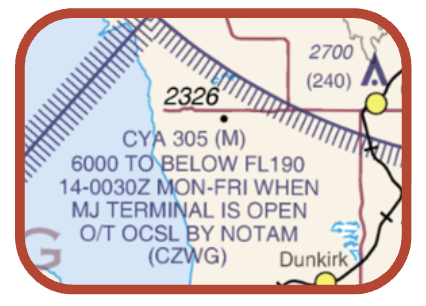
Class F airspace is often described simply as “special-use airspace.” But RPAS pilots still need to know whether they can fly there, who they need permission from or what hazards might be waiting inside.
The most important distinction is between advisory airspace and restricted airspace. One tells you to exercise additional caution. The other tells you to stay out unless you have authorization.
What is Class F airspace?
Class F is airspace designated for a specific activity, hazard or security requirement. It may be controlled, uncontrolled or a combination of both. Its lateral and vertical boundaries are published in the Designated Airspace Handbook (DAH).
In Canada, you will generally encounter three Class F designations:
CYA: Class F Advisory Airspace
Advisory airspace is established where an activity may create a hazard to aircraft but does not necessarily justify prohibiting access.
Common activities include:
- Flight training
- Parachuting
- Gliding
- Hang-gliding
- Aerobatics
- Aircraft testing
- Military operations
A CYA designation does not create the blanket prohibition that restricted airspace. However, it’s there for a reason so you’ll want to pay attention to why.
Before entering a CYA, an RPAS pilot should understand:
- What activity takes place there
- When the area is active
- Its lateral and vertical limits
- Whether the airspace is controlled or uncontrolled
- What procedures are published in the DAH
- Whether current NOTAMs affect the area
The activity may involve fast-moving, difficult-to-detect or unpredictable crewed aircraft. A glider, parachutist or military aircraft may not fit neatly into the traffic assumptions used during an ordinary drone site survey. Flight training, for example, can regularly, legally, bring training aircraft below 400′.
The correct question is not simply, “Am I legally allowed inside?” It is also, “Can I operate here without creating an unacceptable collision risk?”
Advisory does not mean uncontrolled
One common mistake is assuming that CYA airspace must be uncontrolled. It does not.
Class F airspace can be controlled, uncontrolled or partly both. A Basic pilot cannot enter controlled airspace simply because the area is advisory. An Advanced or Level 1 Complex operation may also require separate air traffic control authorization, depending on the location and operation.
The CYA designation describes the special activity. It does not replace the surrounding airspace requirements.
CYR: Class F Restricted Airspace
Restricted airspace is considerably less ambiguous.
Under CAR 601.04, an aircraft may not operate in Class F Special Use Restricted airspace unless authorized by the person identified in the DAH.
That prohibition applies to drones, including microdrones. Being under 250 grams does not change the “restricted” in restricted airspace.
Restricted areas may protect:
- Military activities
- Correctional facilities
- Critical infrastructure
- Government or security operations
- Locations where hazardous activities occur
- Other areas requiring controlled access
The DAH entry identifies the responsible user or controlling agency and provides the applicable procedures. If you want to enter, that is the organization from which you need authorization.
ATC authorization and CYR authorization are not the same thing
Receiving authorization from NAV CANADA to operate in controlled airspace does not automatically authorize entry into a CYR.
Likewise, permission from the CYR’s responsible agency may not eliminate a separate requirement for air traffic control authorization.
Depending on the location, you may need both answers to be yes.
An SFOC should not be assumed to replace CYR authorization unless that approval expressly addresses access to the restricted area.
What about CYD danger areas?
CYD areas are normally established over international waters where activities dangerous to non-participating aircraft may occur.
For RPAS planning, NAV CANADA identifies CYD areas as locations where operations are not permitted without authorization from the responsible user agency.
They may be less common in everyday drone operations but the planning principle is the same as a CYR.
How to read a Class F designation
A Class F area will include an identifier such as CYA123 or CYR456. Depending on the area, you may also see a letter indicating the activity associated with an advisory area.
In the Designated Airspace Handbook you can confirm:
- The area’s designation
- Its horizontal boundaries
- Its floor and ceiling
- Its active dates and times
- The activity conducted inside
- The responsible user or controlling agency
- Any published entry or communication procedures
Current NOTAMs must also be checked because temporary activation, scheduling changes or related restrictions may not be obvious from a static map.
NAV Drone is an excellent planning tool, but pilots remain responsible for understanding what the displayed airspace means.
What different RPAS pilots need to consider
Microdrone pilots
Microdrones are exempt from many Part IX requirements, but they are not exempt from restricted-airspace prohibitions. A sub-250-gram aircraft still cannot enter a CYR without authorization.
Basic pilots
A Basic certificate does not permit operations in controlled airspace. If a CYA overlaps controlled airspace, its advisory status does not make the operation legal under Basic rules.
Advanced pilots
Advanced pilots may be able to operate in controlled airspace with the required authorization. However, entry into a CYR still requires separate authorization from the responsible agency identified in the DAH.
Level 1 Complex operators
For lower-risk BVLOS operations, Class F airspace can also affect the applicable air-risk classification and the required collision-risk mitigations.
A CYA may indicate a higher likelihood of crewed-aircraft activity and could trigger additional requirements involving visual observers or an approved detect-and-avoid system. CYR and CYD operations still require authorization from the applicable agency.
Class F is therefore not merely a shaded area to acknowledge in a site survey. It may materially change whether the operation qualifies, which mitigations are required and whether the flight can proceed at all. In some situations, like a risk management Air Risk Class perspective, CYRs actually make the risk class lower because it’s unlikely you’ll get permission at the same time as others, reducing air risk.
The goal of this blog isn’t to get you sweating, but if you’ve been making any of these faces 😳 🫣 😬 🫤 throughout, it is entirely possible to rescind your RPOC status without penalty and have it reissued once your procedures and documents are where they need to be. You won’t get a red flag on your company profile so there is really no harm in surrendering or cancelling the certificate.
It does not permanently close the door. You can apply for an RPOC again when your operations require it! At that point, you will need to meet the requirements in effect and pay the applicable fee but you will also have a real reason to maintain the system.