
Flight logging is one of the least exciting parts of operating an RPAS program. At least right up until Transport Canada asks to see your records…
A proper log can demonstrate aircraft utilization, maintenance status, crew experience and regulatory compliance. A messy collection of app screenshots, logs on an aircraft many people fly and half-completed spreadsheets may demonstrate something else entirely.
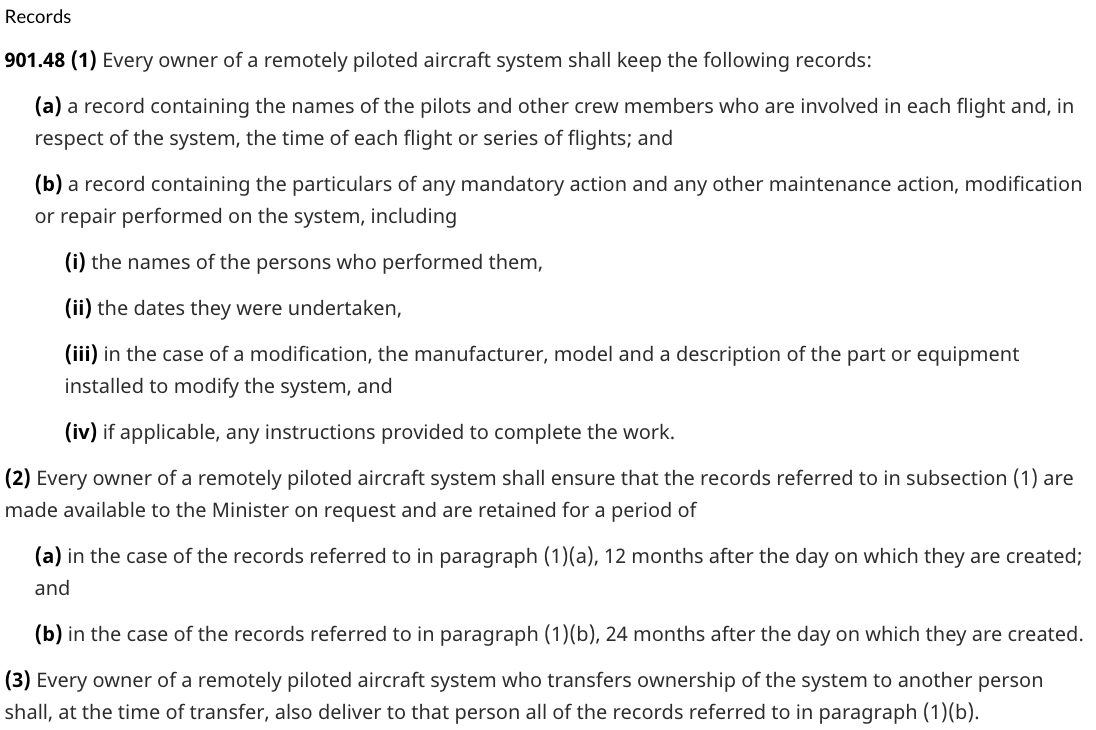
Canadian Aviation Regulation (CAR) 901.48 sets out the basic record-keeping obligations for RPAS owners. It applies whether an aircraft is flown under Basic, Advanced or Level 1 Complex operations.
The regulation is short, but it leaves plenty of room for folks to misinterpret who must keep the records, what constitutes a legal flight log and whether automatically generated flight data is enough.
Let’s clear that up.
CAR 901.48 applies to the owner
The first words of CAR 901.48 are important: “Every owner of a remotely piloted aircraft system shall keep the following records.”
The legal responsibility therefore follows ownership of the RPAS, not necessarily the person flying it.
If you own and fly your own drone, you are both the pilot and the person responsible for maintaining the records.
If a business, municipality, public-safety agency or other organization owns the aircraft, that organization must ensure the required records are created, retained and available to Transport Canada. Pilots may enter the information, but assigning data entry to pilots does not transfer the owner’s regulatory responsibility.
This is why a drone program needs an actual record-keeping process.
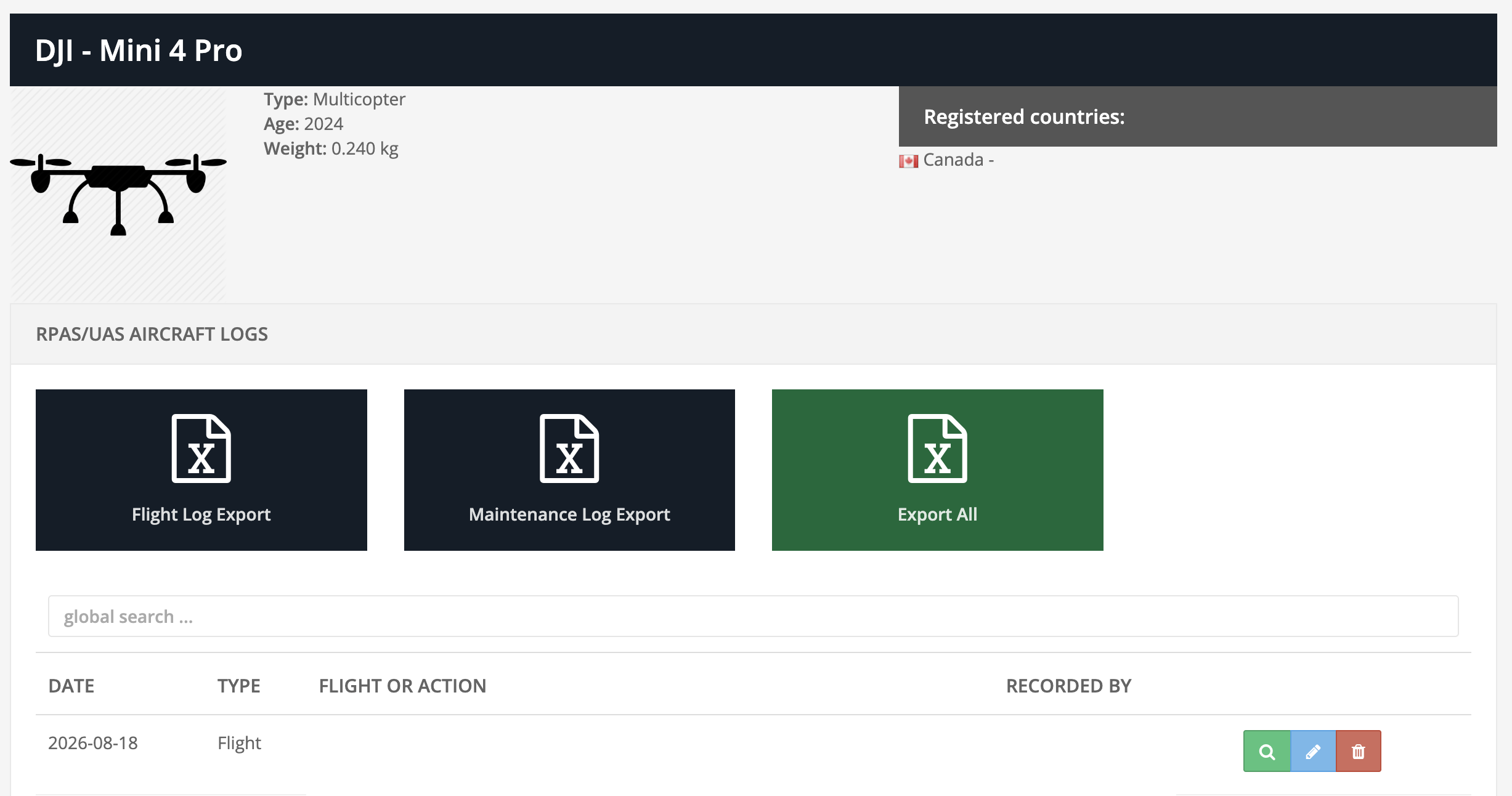
Log image above provided by the Flight Insight platform.
What records does CAR 901.48 require?
CAR 901.48 creates two main record categories: flight records and technical records.
Flight and crew records
For each flight or series of flights, the owner must record:
- The names of the pilots involved
- The names of other crew members involved
- The time of each flight or series of flights
The regulation does not prescribe a Transport Canada form, a specific logbook design or a particular software platform.
A record is compliant because it contains the required information, is connected to the correct RPAS, is protected and retrievable, and is retained for the required period.
Although the regulation permits a “series of flights” to be grouped, the entry still needs to be understandable. “Flew several times this summer” is unlikely to help the owner, an inspector or anyone else. Logging a series of 3 batteries worth of flights in one day as 1.5 hrs of flight time is reasonable. A defensible entry should identify the date, aircraft, crew, operating period and total flight time.
Maintenance, modification and repair records
The owner must also record the particulars of:
- Mandatory actions
- Maintenance performed on the system
- Modifications
- Repairs
Those records must include:
- The name of the person who performed the work
- The date it was completed
- For a modification, the manufacturer and model of the installed equipment
- A description of the installed equipment
- Any instructions used to complete the work, if applicable
“Changed prop” might remind you what happened but we can do better than that.
Which aircraft? Which propeller? Who changed it? Why? When? Which instructions were followed? Was the aircraft inspected or tested afterward? By the same person or a different one? Did it get installed correctly the first time or did changes have to be made?
The regulation establishes the minimum information. A useful technical record supplies enough context to answer those questions without relying on someone’s memory.
Paper, spreadsheet or software?
All of them can work.
CAR 103.04 allows electronic records if they are protected against inadvertent loss, destruction and tampering and can be printed and provided to the Minister on reasonable notice. The best system is therefore not necessarily the most expensive one. It is the system your pilots will consistently use and your organization can reliably preserve. CAR 103.04 contains the electronic record requirements.
Paper logbooks
A paper logbook can work well for an individual owner with one aircraft and relatively few flights.
Its strengths are simplicity and independence from software subscriptions. Its weaknesses are limited searchability, no automatic backup and poor suitability for pilots operating from different locations.
If paper is used, write legibly, store it securely and create periodic scans.
Spreadsheets
A well-designed spreadsheet is inexpensive, flexible and sufficient for many smaller programs. Separate tabs can track flights, aircraft, maintenance, batteries, personnel and recurring due dates.
The risk is uncontrolled editing. A shared spreadsheet should have:
- Standardized fields
- Restricted permissions
- Version history
- A backup process
- Clear responsibility for reviewing entries
If anyone with access can rewrite last year’s records, the file is not well protected against tampering.
Manufacturer and flight-control records
Manufacturer apps and flight-control systems can automatically capture flight dates, durations, aircraft serial numbers, routes and battery information.
That information is useful supporting evidence, but it is not automatically a complete CAR 901.48 record. Telemetry may not reliably identify every pilot and crew member, explain how flights were grouped or document maintenance and modifications.
It may also be connected to an employee’s personal account or retained only while a particular service remains available.
Treat automatic flight data as an input to the official record unless you have confirmed that the system captures every required field and meets your retention, backup and export requirements.
Fleet-management platforms
Dedicated RPAS management software is generally the strongest option for organizations with several aircraft, multiple pilots or recurring operations. These systems can connect flight records with crew qualifications, aircraft status, maintenance, risk assessments and occurrence reports.
Software does not create compliance by itself, however. Required fields must be configured, responsibilities assigned, entries reviewed and data backed up.
An expensive empty database is still an empty database.
A hybrid approach
For many organizations, the most practical approach is to import telemetry automatically and then require the pilot to confirm the aircraft, crew, project and any defects before closing the flight.
The important part is identifying one authoritative record. If some flights are in an app, others are in a spreadsheet and maintenance lives in somebody’s email, the organization does not have three record systems. It has one incomplete system spread across three locations.
How long must records be kept?
The required retention periods are different:
- Technical logs must be kept for 24 months
- Flight logs must be kept for 12 months
These are minimums, not recommended deletion dates. Many operators retain records longer to support maintenance history, warranty claims, insurance matters, pilot experience and client requirements.
The owner must also make the records available to the Minister on request.
There is one more easily missed requirement: when ownership of the RPAS is transferred, the outgoing owner must provide the new owner with all required maintenance, modification and repair records. The technical history is supposed to travel with the system.
Why sloppy record-keeping can cost you
Each of CAR 901.48’s three subsections carries a maximum administrative monetary penalty of $1,000 for an individual and $5,000 for a corporation.
The regulatory penalty is only the most obvious cost.
Incomplete records can also make it difficult to:
- Prove required maintenance was completed
- Establish who was acting as pilot or crew
- Verify aircraft or pilot experience
- Support an insurance claim
- Respond to a client audit
- Identify recurring defects
- Demonstrate due diligence after an occurrence
- Provide a complete technical history when selling an aircraft
Good records do not prove every operational decision was correct. They do show what happened, who was involved and how the system was maintained.
When questions arise, that is much more useful than trying to reconstruct six months of operations from calendar invitations and memory.
What should an individual pilot be doing?
An individual pilot should first know who owns the RPAS.
If you own it, CAR 901.48 is your responsibility. Keep both the flight records and technical records, even if the aircraft is only used occasionally.
If your employer or client owns it, follow the owner’s logging process and complete the record promptly after each operation. At minimum, provide accurate information about:
- The aircraft flown
- Your name and the other crew involved
- The flight time
- Defects, damage or unusual system behaviour
- Maintenance or field replacements you performed
It is also wise to maintain a separate personal pilot log showing your experience by date, aircraft and role. That personal log does not replace the owner’s CAR 901.48 record, but it can support employment, competency assessments and authorization for more complex work.
CAR 901.49 creates another pilot-specific obligation after certain incidents or accidents. When an occurrence requires operations to stop until its cause is analyzed and corrective action is taken, the pilot must retain the analysis for 12 months and make it available on request.
What should a drone program manager be doing?
The person responsible for a drone program, like the Accountable Executive, needs to think beyond individual entries and build a controlled system.
That should include:
- A written procedure: Define who opens a record, who completes it, when it is due and who reviews it.
- Unique aircraft identification: Use registration numbers and fleet IDs consistently. “Mavic 3” is not sufficient when the organization owns three of them.
- Mandatory fields: Make it difficult to close a flight without recording the aircraft, pilot, crew and flight time.
- Technical-record integration: Aircraft hours and reported defects should feed the maintenance system.
- Retention and backup: Protect records for at least the regulatory period and verify that they can be exported.
- Access control: Allow pilots to make necessary entries without giving everyone the ability to erase the fleet history.
- Quality checks: Periodically compare telemetry, project records and maintenance entries against the official log.
- Aircraft transfer procedures: Ensure the technical history accompanies an aircraft when it is sold or transferred.
RPOC holders have additional organizational record requirements under CAR 901.223. These include records relating to pilots-in-command and crew, employees and representatives, training, aircraft registration numbers and maintenance actions.
If the RPOC holder also owns the aircraft, CAR 901.48 still applies. The requirements overlap, but one does not replace the other.