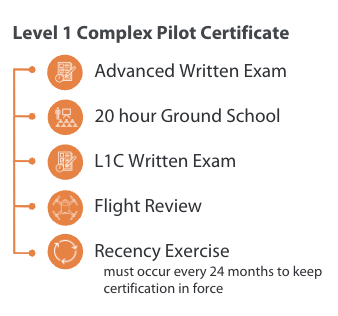
The Level 1 Complex Pilot Certificate is Canada’s certification for lower-risk beyond visual line-of-sight operations. The process is more involved than Basic or Advanced certification: you must pass two Transport Canada exams, complete at least 20 hours of ground school, pass an in-person Level 1 Complex flight review and then apply for your certificate.
Read on to learn some tips and tricks to help you gain confidence and competence as you get your certification!
Pass the Advanced exam
The first requirement for Level 1 Complex certification is passing Transport Canada’s online Advanced Exam.
You must be at least 16 years old to write the Advanced Exam, although you must be at least 18 to receive a Level 1 Complex certificate. The exam currently includes:
- 50 multiple-choice questions
- 60 minutes to complete the exam
- A passing score of 80%
- A fee of ~$10* for each attempt
The Advanced Exam is completed through Transport Canada’s Drone Management Portal.
*The fee increases every year with inflation. In 2026, it's $10.17.
The Level 1 Complex curriculum builds on the Advanced knowledge requirements, so this exam must be completed before beginning the Level 1 Complex certification process.
Important Note!
You do not need to complete an Advanced flight review or hold an Advanced Pilot Certificate before pursuing Level 1 Complex certification.
You only need to have passed the Advanced Exam.
If you have passed the Advanced Exam but still hold a Basic Pilot Certificate because you have not completed an Advanced flight review, you can proceed directly to Level 1 Complex ground school. When you get to the flight review step, it will include aspects of both the Advanced and Level 1 Complex requirements. It ends up being just slightly longer than if you did them separately, because there’s some overlap in requirements.
If you already hold an Advanced certificate, you have met the Advanced Exam prerequisite and can begin Level 1 Complex ground school.
Complete Level 1 Complex Ground School
Unlike Basic and Advanced certification, ground school is mandatory for Level 1 Complex pilots.
You must complete at least 20 hours of Level 1 Complex ground school through a self-declared TP 15530 training provider before you can write the Transport Canada exam. The ground school you took before getting your advanced exam does not count toward this 20 hour requirement because it was based on a different TP, and therefore different curriculum. While similar to the 8 knowledge areas you would have seen on Basic and Advanced, you’ll see increased depth and topics like:
- Canadian aviation regulations for BVLOS operations
- RPAS Operator Certificate requirements
- Population density and operating environments
- Safety assurance declarations
- Command-and-control link performance
- Containment, detection and operational volumes
- Detect, Alert and Avoid systems
- Standard 923 vision-based detect and avoid
- Flight planning for BVLOS operations
- Contingency procedures
- Crew resource management
Our FLYY Level 1 Complex Ground School meets Transport Canada’s TP 15530 training requirements. It includes more than 20 hours of instructor-led content, knowledge-confirmation exercises, operational scenarios, exam preparation and supporting resources.
The course is available through live and recorded instruction, allowing you to complete the required material on your schedule while retaining access to instructor support.
Writing the L1C Transport Canada Exam
After passing the Advanced Exam and completing the mandatory ground school, you can write Transport Canada’s Level 1 Complex Exam. Technically you can write the exam before completing ground school, but that’s kinda making it unnecessarily hard on yourself.
You must be at least 18 years old to write it. The exam currently includes:
- 50 multiple-choice questions
- 90 minutes to complete the exam
- A passing score of 80%
- A fee of ~$10* for each attempt
Your result is available immediately after you finish. If you do not pass, you must wait at least 24 hours before trying again, and the exam fee applies to each attempt.
*The fee increases every year with inflation. In 2026, it's $10.17.
Preparing for your Flight Review
The Level 1 Complex flight review is an in-person assessment completed with a Transport Canada-approved Level 1 Complex flight reviewer.
It builds on the Advanced flight-review exercises but also assesses your ability to plan and manage a lower-risk BVLOS operation. You should arrive prepared to demonstrate or explain:
- Flight planning and site-survey procedures
- Population-density assessment
- Airspace, aerodrome and weather research
- NOTAM interpretation
- Operational volumes, contingency volumes and ground-risk buffers
- Normal, contingency and emergency procedures
- Crew and visual-observer briefings
- RPAS and command-and-control link limitations
- Detect and Avoid procedures
- Lost-link, flyaway and intruder-response procedures
- Safe take-off, navigation and landing
- Operation using the ground control station without direct visual reference to the aircraft
- Crew resource management and communications
- Post-flight procedures and record keeping
Transport Canada’s Flight Reviewer’s Guide identifies the exercises and performance criteria used during the assessment.
The flight review is an evaluation rather than a training flight. You should already be comfortable with the aircraft, ground control station, procedures and crew coordination you intend to use. Most schools, including ours, provide you with preparation materials packaged together with the cost of your review so you can arrive at your review with confidence.
Important Note!
One of the most important differences between an Advanced and Level 1 Complex flight review is the Detect, Alert and Avoid requirement.
During portions of the Level 1 Complex review, you must control the aircraft without maintaining direct visual reference to it (aka you’ll turn around so your back is to the drone). You will operate using the ground control station while demonstrating that you can detect and respond to conflicting air traffic using either:
- A technical Detect, Alert and Avoid system; or
- A visual observer providing vision-based Detect and Avoid support.
You will also be expected to respond to a simulated intruder alert and use your DAA system or visual observer effectively while navigating to and landing at the take-off point or a planned alternate landing area.
Complete Your Flight Review
Flight reviews are completed through a self-declared RPAS flight school. When booking, you will need to provide:
- Proof that you passed the Advanced Exam
- Proof that you passed the Level 1 Complex Exam
- Your Drone Management Portal reference numbers
- Your existing Basic or Advanced Pilot Certificate
- Valid government-issued identification showing your name and date of birth
- The Certificate of Registration for the aircraft used during the review
- The required aircraft manuals, procedures and supporting documents
- Your DAA system or trained visual observer
And for us, also that you’ve completed the prep course and the mock flight plan homework.
Your reviewer will assess your pre-flight preparation, knowledge, procedures and ability to conduct a safe flight. Flight-review fees are established by the individual flight school or reviewer rather than Transport Canada.
Pass or fail, your reviewer will let you know and submit the result to Transport Canada through the Drone Management Portal. This is normally completed within 24 hours, and you will receive an email when it is processed.
If you do not pass, you can attempt another flight review beginning the following day. There is no limit on the number of attempts, but you may need to pay the flight-review fee each time.
Apply for Your L1C Pilot Certificate
Passing the flight review does not automatically issue your certificate.
Once your successful result has been entered, sign in to the Drone Management Portal and apply for your Pilot Certificate – Level 1 Complex Operations.
Transport Canada currently charges a $125 issuance fee. Once the application and payment are complete, your certificate is issued through the portal.
A Level 1 Complex Pilot Certificate also allows you to conduct Basic and Advanced operations.
Receiving your Level 1 Complex certificate does not, by itself, allow you to begin conducting lower-risk BVLOS operations independently.
To exercise Level 1 Complex privileges, you must also operate under an RPAS Operator Certificate. This could mean holding an RPOC yourself or operating as an employee or agent of an organization that holds one.
The operation must also use an RPAS that meets the applicable safety-assurance requirements and remain within the permitted Level 1 Complex operating environment.
Keeping Current
Your Pilot Certificate does not expire, but to exercise the privileges of your certificate, you must have completed an accepted recency activity within the 24 months before your flight. For the first 24 months, your certificate issuance counts, so once you pass the exam set yourself a calendar reminder for ~23 months later, so you give yourself time to get it done.
This could include rewriting an applicable Transport Canada RPAS exam, completing a flight review or completing an accepted recurrent training activity, such as Transport Canada’s self-paced study program. You can read more about the available options in our guide to maintaining your RPAS pilot recency.
You must also keep proof of your recency activity and be able to access both it and your pilot certificate when operating.
Resources
RPAS 101
RPAS 101 is a free general-knowledge guide developed through cooperation between Transport Canada and the Aerial Evolution Association of Canada.
I was one of the contributors who helped write RPAS 101. We developed it to function much like a driver’s handbook. It’s an accessible starting point for understanding the information Canadian drone pilots need. It is useful for both new pilots and experienced operators looking for a refresher.
Transport Canada Aeronautical Information Manual
The Transport Canada Aeronautical Information Manual, commonly called the TC AIM, explains the rules and procedures used in Canadian aviation.
Drone pilots should be familiar with the dedicated Remotely Piloted Aircraft chapter, but relevant information also appears in sections covering airspace, aerodromes, weather, communications and navigation. The AIM is updated regularly, so make sure you are using the current edition.
Canadian Aviation Regulations
I linked to a few specific areas in the text above, but the CARs are a helpful resource to have open during the exam. They aren’t the most fun to read “cover to cover” but work well as a reference if you need clarity or the official information source on something.
TP 15530 Knowledge Requirements
TP 15530 is the official outline of the knowledge required in Level 1 Complex ground school and assessed on the exam.
Flight Reviewer’s Guide
Transport Canada’s Flight Reviewer’s Guide explains the performance standards and exercises used during an Advanced flight review. Reviewing it before your assessment will help you understand what you will be expected to prepare, explain and demonstrate.
Standards
Standard 922 – RPAS Safety Assurance establishes the technical requirements that may apply to RPAS used for Advanced and Level 1 Complex operations.
Standard 923 – Vision-Based Detect and Avoid establishes the conditions under which a visual observer can provide DAA support when the system does not have a declaration against section 922.10.
Ready to get started?
If a Level 1 Complex certification is the right fit for your operations, the process is:
- Pass the Transport Canada Advanced Exam.
- Complete at least 20 hours of ground school through a TP 15530 training provider.
- Write and pass the Level 1 Complex Exam.
- Prepare your aircraft, procedures and DAA method for the flight review.
- Complete and pass an in-person Level 1 Complex flight review.
- Apply for your Pilot Certificate – Level 1 Complex Operations.
- Operate under an RPOC and maintain your 24-month recency.
The FLYY Level 1 Complex Ground School provides the mandatory training, instructor support and exam preparation required to move through the certification process.
Once you have passed the exam, the FLYY Level 1 Complex Flight Review and Guide will help you prepare for the final in-person assessment including the BVLOS planning elements that distinguish it from an Advanced flight review.