When mining companies consider adopting drone technology, the conversation often starts with the aircraft. A better place to start is with the problem it needs to solve and how often it needs to solve it.
From surveying and stockpile measurement to inspections, progress monitoring and emergency response, drones can collect detailed information quickly while reducing the number of people exposed to active or hazardous areas. The business case, however, is not simply a choice between traditional methods and drones. Companies must also decide whether it makes more sense to outsource the work or develop the capability in-house.
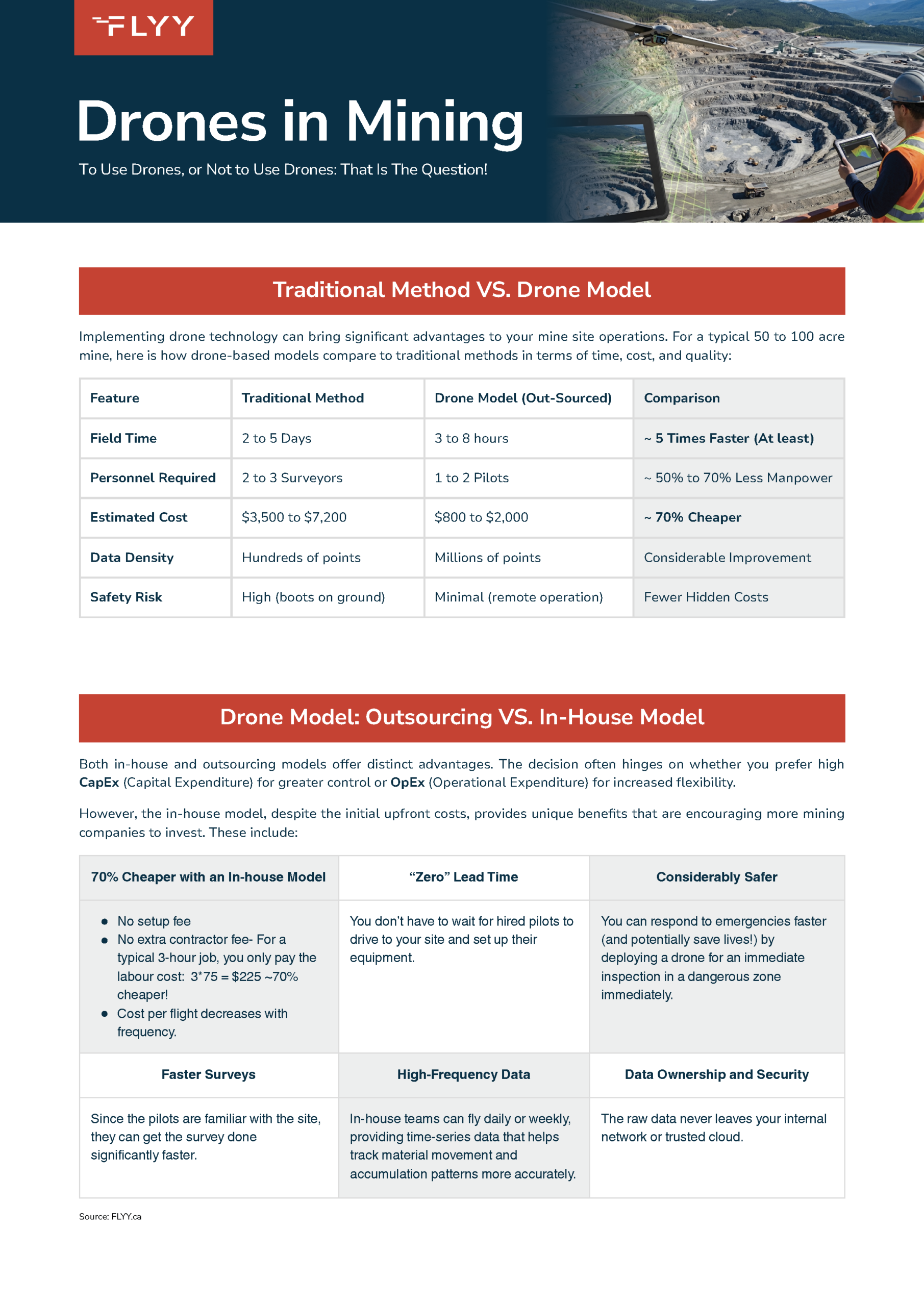
The infographic below compares these options for a typical 50- to 100-acre mine and highlights the trade-offs in time, cost, staffing, data quality and operational flexibility.
Choosing the Right Model
There is no single model that will be right for every operation. For occasional or highly specialized work, outsourcing may provide access to experienced pilots and equipment without the upfront investment. When flights are needed regularly—or when rapid response, data security and consistent data collection matter—an in-house program can quickly become the more practical and cost-effective option.
Ultimately, the value of a drone program is not just in completing a survey for less. It is in collecting better information more often, keeping people out of hazardous areas and helping teams make faster, more informed decisions.
Whichever model you choose, the aircraft is only one part of the equation. Safe and effective operations also depend on properly trained pilots, the right payload and software, compliant procedures, and a clear plan for turning the data collected into information your team can actually use.